The Candela P-12 electric hydrofoiling ferry has completed a new, record-breaking voyage from Sweden’s west coast to Norway’s capital of Oslo.
The longest journey ever taken by an electric passenger ship; the Candela P-12 travelled began the 160-nautical-mile journey in Gothenburg, Sweden, and was welcomed in Oslo by officials and media.
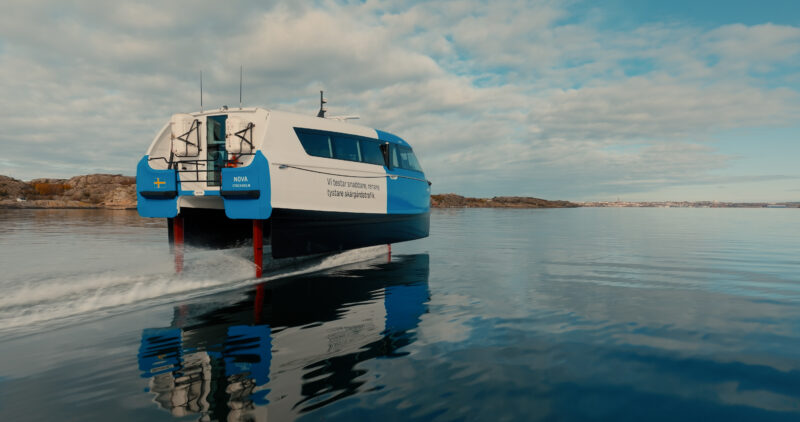
Named as the world’s first serial-production electric hydrofoil ferry; the Candela P-12 possesses computer-controlled submerged wings underneath its hull, which lift the vessel above the water at speeds exceeding 20 knots.
Having performed a number of services for Stockholm’s public transport system, the vessel, which also possesses the accolade of the fastest electric passenger ferry in operation, is capable of travelling at a speed of 25 knots, and has exceeded 30 knots during trials, with a range of up to 40 nautical miles at cruising speed on a single charge.
A number of electric high-speed ferries are already in operation in Oslo, with the Candela P-12’s arrival aiming to outshine Oslo’s fastest electric passenger ferry m/s Baronen, which operates a fixed 10-nautical-mile route and relies on swapping a deck-mounted battery container with several megawatt-hours of capacity at the end of each trip.
Candela believes its ability to charge from standard DC fast chargers will continue to give it an edge over existing electric passenger ferries. On this particular trip, the vessel was charged using a portable 360 kW Skagerak Energi Move DC charger connected to a mobile battery system, towed behind a Ford F-150 Lightning electric pickup.
Gabriele De Mattia, Project Engineer at Candela and Lead Engineer for the Voyage, said:Charging infrastructure is the hidden cost of electrifying conventional vessels.
In many cases, building megawatt-scale chargers—especially where the grid is weak or undeveloped—can cost as much as the vessels themselves. The breakthrough with P-12 is that it is fast to charge and extremely flexible in where it can operate.
The 160-nautical-mile journey was completed over three days, and included demonstration and charging stops along the route. All in, the electricity cost for the journey, the world’s longest with an electric vessel, amounted to just over 200 EUR – according to Candela.